Artificial intelligence just crossed a new line in mathematical discovery.
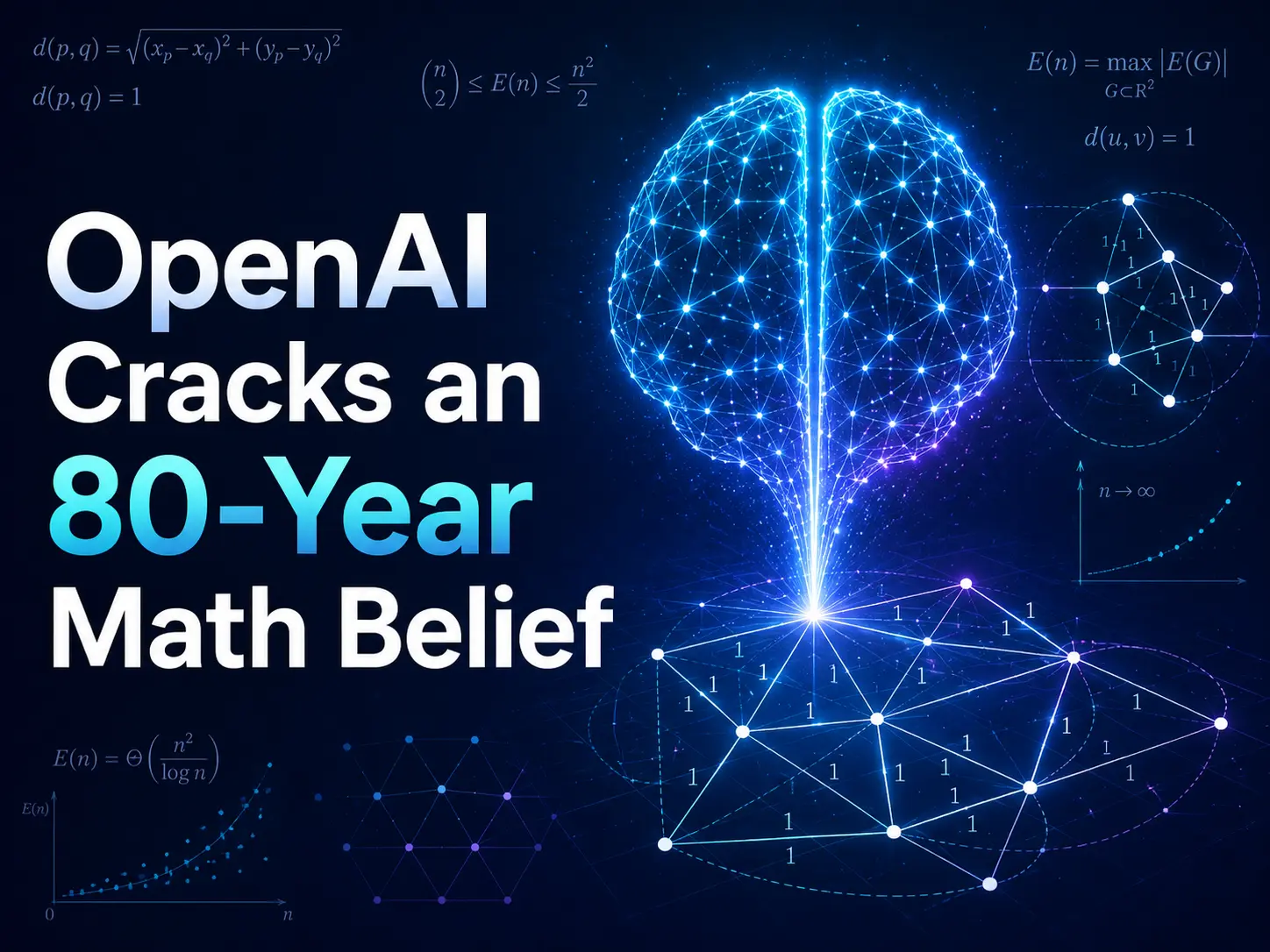
OpenAI announced that one of its internal general-purpose reasoning models disproved a long-standing belief connected to the famous unit distance problem, a question first raised by mathematician Paul Erdős in 1946. The problem sounds simple: if you place n points on a flat plane, how many pairs of points can be exactly one unit apart? But for nearly 80 years, this question shaped serious research in discrete geometry.
The surprising part is not just that a new answer was found. The bigger story is that OpenAI says the result came from a general-purpose AI reasoning model, not a system built only for mathematics. According to OpenAI, the proof was checked by external mathematicians and uses advanced ideas from algebraic number theory, a field that was not expected to unlock this geometry problem so directly.
For AI watchers, researchers, developers, and businesses, this is bigger than a math headline. It shows that advanced AI may be moving from answering questions to generating original discoveries.
The unit distance problem asks:
How many pairs of points can be exactly one unit apart among n points in a plane?
Imagine placing dots on paper. Now connect every pair of dots that are exactly one unit away from each other. The challenge is to arrange the dots in a way that creates as many same-length connections as possible.
For decades, mathematicians believed that square-grid-style arrangements were close to the best possible solution. OpenAI’s new result challenges that belief. The model found an infinite family of point sets that create more unit-distance pairs than the old conjecture allowed.
In simple words, AI found a better way to arrange the dots.
The old belief was that the number of unit-distance pairs could not grow much faster than almost linear growth. In technical terms, Erdős conjectured an upper bound close to:
n¹⁺ᵒ⁽¹⁾
OpenAI’s model produced a counterexample. It showed that for infinitely many values of n, there are point configurations with at least:
n¹⁺δ
unit-distance pairs, where δ is a fixed positive number. OpenAI also noted that a refinement by Princeton professor Will Sawin suggests δ can be taken as 0.014.
That may look small, but in mathematics, it is a major shift. It means the previous belief was not just incomplete. It was wrong.
AI has already shown impressive performance in coding, language, image generation, and exams. But original mathematical discovery is different.
Math requires long chains of logic. One weak step can break the entire proof. That is why this result matters. OpenAI says the model created a proof that survived expert checking, and the companion paper describes it as a human-digested version of the AI-generated counterexample.
This is not the same as a chatbot giving a homework answer. It is closer to AI contributing a new idea to frontier research.
Google DeepMind had already shown strong progress in AI mathematics with AlphaProof and AlphaGeometry, which reached silver-medal standard on International Mathematical Olympiad problems in 2024. But OpenAI’s claim is different because this was not just solving a known contest problem. It was a contribution to an open research question.
One of the most interesting parts of the discovery is the method.
The problem belongs to discrete geometry, but the proof uses ideas from algebraic number theory. OpenAI says the argument relies on concepts such as algebraic number fields, infinite class field towers, and Golod-Shafarevich theory.
That matters because breakthroughs often happen when two distant areas connect.
In this case, AI did not simply try to improve the old square-grid idea. It explored a different mathematical direction and found a path that many experts did not expect to work.
That is the part researchers should pay attention to. AI may become powerful not only because it calculates faster, but because it can test unusual connections across fields.
Not completely.
This result disproves a central conjecture and changes the known lower-bound story. But the full unit distance problem remains open because mathematicians still do not know the exact maximum number of unit-distance pairs possible for every large n.
OpenAI’s own article explains that the best upper bound remains O(n⁴ᐟ³), a result dating back to work by Spencer, Szemerédi, and Trotter in 1984.
So the correct takeaway is:
AI did not finish the entire unit distance problem.
AI did disprove a major long-held belief inside it.
That difference is important.
Mathematics is one of the cleanest tests for AI reasoning. A proof is either valid or it is not. There is less room for vague answers.
If AI can produce new mathematical constructions, it may also become useful in other research-heavy fields, including:
OpenAI also framed the result this way, saying better mathematical reasoning could help AI connect ideas across distant fields and contribute to harder scientific and engineering problems.
For businesses and creators following AI trends, this is a signal. The next wave of AI may not only automate tasks. It may help generate new knowledge.
This breakthrough does not mean mathematicians are no longer needed. In fact, it shows the opposite.
The model generated the core proof, but human experts verified, refined, explained, and contextualized it. The companion paper includes reflections from leading mathematicians including Noga Alon, Tim Gowers, Thomas Bloom, Will Sawin, Arul Shankar, Jacob Tsimerman, Victor Wang, Daniel Litt, and Melanie Matchett Wood.
That is likely the near future of serious AI research:
The winning model may not be “AI replaces experts.” It may be “experts with AI move faster than experts without it.”
At FutureTools, we track AI because the most important changes often start as technical breakthroughs before they become everyday tools.
This OpenAI math breakthrough is one of those moments. Today, it is a discrete geometry proof. Tomorrow, the same kind of reasoning could help researchers design better drugs, discover new materials, improve engineering systems, or build safer AI.
The big lesson is simple:
AI is becoming more than a productivity assistant. It is becoming a research partner.
The AI tools we use today write emails, summarize documents, generate images, and speed up coding. The tools coming next may help solve problems that humans have struggled with for decades.
OpenAI’s AI model disproving a major Erdős-related geometry belief is not just another AI news story. It is a sign that reasoning models are entering a new phase.
They are no longer limited to repeating what already exists. In the right conditions, with expert verification, they may help create new knowledge.
That makes this one of the most important AI research updates of 2026 so far.
For anyone watching the future of AI, the message is clear: the next frontier is not just smarter chatbots. It is AI systems that can reason, discover, and help expand the boundaries of human knowledge.

Ahmed Al-Farsi highlights standout AI innovations, startups, and use cases, spotlighting how emerging technologies are shaping businesses, creators, and the future of work.