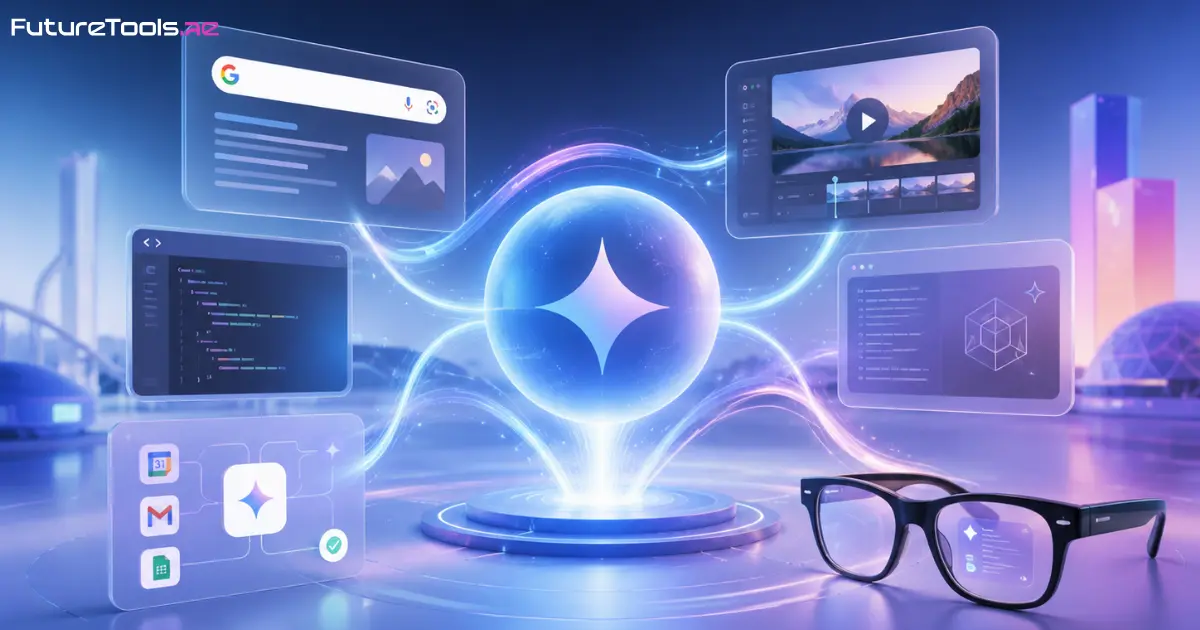
Google I/O 2026 made one thing very clear: Gemini is no longer just a chatbot or a model sitting inside one app. Google is turning Gemini into the agentic engine behind Search, Workspace, video creation, smart glasses, coding tools and daily digital workflows.
This year’s I/O theme was all about action. Not just asking AI for answers, but letting AI plan, search, create, summarize, monitor and complete tasks across the apps people already use every day.
Google called this the “agentic Gemini era,” and the announcements show exactly why. Gemini is being pushed deeper into Google Search, the Gemini app, video generation, personal agents, developer tools and Android XR devices.
For users, creators and businesses, this is a major shift. AI is moving from simple chat responses to full digital assistance.
The biggest story from Google I/O 2026 was not one single product. It was the direction.
Google is building a world where Gemini can sit inside your daily workflow and keep working even when you are not actively prompting it. That means AI can monitor information, prepare summaries, help with research, generate creative assets, build interfaces and support multi-step tasks.
Google also shared major scale numbers around AI adoption. According to Google, its systems are now processing more than 3.2 quadrillion tokens per month across its surfaces, and more than 8.5 million developers are building with its models monthly.
That scale matters because Google already owns many of the daily digital spaces people use: Search, Gmail, Docs, Android, YouTube, Chrome and Maps. If Gemini becomes active across all of them, AI agents will become normal for millions of users, not just early adopters.
One of the biggest announcements was Gemini 3.5 Flash. Google describes it as the first model in its new Gemini 3.5 family, built for complex agentic workflows, coding and long-horizon tasks. The model is available through the Gemini app, AI Mode in Google Search, Google Antigravity, Gemini API, Google AI Studio, Android Studio and enterprise products.
The key point is speed. Google says Gemini 3.5 Flash is designed to deliver frontier-level performance while staying fast enough for real-time work. That is important because AI agents need to make many small decisions quickly. A slow model can answer a question, but a fast model can run a workflow.
For businesses, this means AI can move beyond content generation. It can help with reporting, data analysis, code maintenance, document processing, invoice review, research and internal automation.
This is where AI tools become less like “apps” and more like digital workers.
Google also introduced Gemini Omni Flash, a new model focused on multimodal video generation and editing. Omni can combine text, images, audio and video inputs to create high-quality video outputs. It also supports conversational editing, so users can ask for changes in natural language instead of using complex editing software.
This could be a big moment for creators, marketers and small businesses.
Instead of hiring a full production team for every short video, users may soon be able to upload clips, describe a concept and generate polished video variations. Google says Gemini Omni Flash is rolling out through the Gemini app, Google Flow and YouTube Shorts, with developer and enterprise API access planned later.
For FutureTools readers, this is worth watching closely. AI video is becoming more practical, more editable and more connected to everyday platforms.
Another major update is Gemini Spark, Google’s new personal AI agent. Google describes Spark as a 24/7 agent that can help manage tasks across Workspace tools like Gmail, Docs and Slides. It is cloud-based, which means it can keep working even when your laptop is closed or your phone is locked.
This is a big shift from passive AI to proactive AI.
Gemini Spark can help with recurring tasks, inbox monitoring, daily digests, workflow creation and multi-step document work. Google also said Gemini is adding connected app support through MCP connections, including Canva, OpenTable and Instacart.
For business users, this is where AI becomes truly useful. Imagine asking an AI agent to collect meeting notes, turn them into a Google Doc, prepare the email and remind you of next steps. That is the type of workflow Google is aiming for.
Search also received one of its biggest upgrades in years. Google said it is bringing Gemini 3.5 Flash into AI Mode as the default model globally. It also introduced a redesigned AI-powered Search box that can handle text, images, files, videos and Chrome tabs as inputs.
This means Search is becoming less about typing keywords and more about explaining what you need.
Google is also introducing Search agents. These agents can monitor the web, news, shopping, finance, sports and other live data sources in the background. For example, a user could ask an agent to track apartment listings, product drops or changing prices and receive synthesized updates when something relevant appears.
This matters for SEO too. If Search becomes more agentic, websites will need to provide clear, structured and trustworthy information that AI systems can understand and summarize.
For publishers and brands, this is another reminder: content needs to answer real user intent, not just target keywords.
Google also showed its renewed smart glasses push with Intelligent Eyewear. These Gemini-powered glasses are being developed with partners including Samsung, Gentle Monster and Warby Parker. Google says audio glasses will launch first later this fall, followed by display glasses that can show information directly in the user’s view.
The glasses are designed for hands-free help. Users will be able to ask Gemini about what they see, get directions, send messages, capture photos, translate speech or text, and complete tasks through voice commands. Google says the glasses will pair with both Android and iOS phones.
This is important because AI is moving beyond screens. The next wave of tools may not live only inside browsers and apps. They may become wearable, voice-first and always available.
Google was not the only major AI story of the day. Andrej Karpathy, an OpenAI co-founder and former Tesla AI executive, has joined Anthropic. Reuters reported that he has joined Anthropic’s pretraining team and will work under Nick Joseph, the company’s head of pretraining.
This is a major talent win for Anthropic. Karpathy has been one of the most influential public voices in AI education, coding and model development. His move also shows how intense the AI talent race has become.
The timing is interesting. While Google is pushing Gemini agents across consumer products, Anthropic is strengthening the research and training side of Claude. Both strategies point to the same future: AI systems that can reason, act and improve workflows at scale.
Another practical AI trend from the same news cycle is automated business reporting. The Rundown highlighted a workflow where users connect AI coding tools like Codex or Claude Code with Google Analytics through Composio, then generate structured Markdown reports that can be scheduled weekly.
This is one of the most useful AI use cases for businesses.
Instead of manually checking Google Analytics, exporting data and writing reports, teams can let AI inspect traffic trends, summarize changes, create tables and recommend next steps. The same approach can apply to YouTube, Shopify, ads, CRM data and customer support reports.
For small businesses, this can save hours every week. For agencies, it can improve client reporting. For founders, it turns scattered data into clear decisions.
The Rundown also highlighted several tools and releases from this AI news cycle, including Metabind, Gemini 3.5 Flash, Gemini Spark and Gemini Omni Flash.
Here is the simple FutureTools breakdown:
| Tool | What It Does | Why It Matters |
|---|---|---|
| Metabind | Helps build native MCP apps with interactive UI. | Useful for connecting AI assistants with real app workflows. |
| Gemini 3.5 Flash | A fast AI model for agents, coding, and workflows. | Makes AI agents more practical and responsive. |
| Gemini Spark | A 24/7 personal AI agent for everyday tasks. | Moves AI from answering questions to doing tasks. |
| Gemini Omni Flash | Creates and edits videos using text, image, audio, and video inputs. | Makes video creation easier for creators and businesses. |
The message is simple: businesses should stop thinking about AI as only a content writing tool.
AI is now becoming useful for operations, reporting, customer support, research, creative production, coding, scheduling and internal workflow automation. The companies that benefit most will be the ones that learn how to combine AI tools with clear processes.
For example, a business can use AI to:
The next stage of AI is not just “ask and answer.” It is “assign and review.”
Google I/O 2026 showed that the AI race is entering a new stage. Models are getting faster, tools are becoming more connected and agents are starting to work across the apps people already use.
Gemini 3.5 Flash, Gemini Omni, Gemini Spark, AI-powered Search and Intelligent Eyewear all point in the same direction: AI is becoming more active, more visual, more personal and more integrated into daily life.
Creators can produce content faster, while businesses gain better automation across daily operations. Developers benefit from more agentic coding support, and everyday users get AI assistance without needing perfect prompts every time.
At FutureTools, we will continue tracking the best AI tools, workflows and updates so you can understand what matters and use AI before your competitors do.

Alex reviews AI tools hands-on, testing features, pricing, and real-world use cases to help creators, founders, and teams choose the right tools with confidence.