Search is changing faster than users can agree on.
Google is moving Search deeper into AI. It wants users to ask longer questions, continue conversations, upload files, use images, and let AI agents do more of the searching for them. For many people, that sounds useful. For others, it feels like the web is being replaced by a machine-generated answer box.
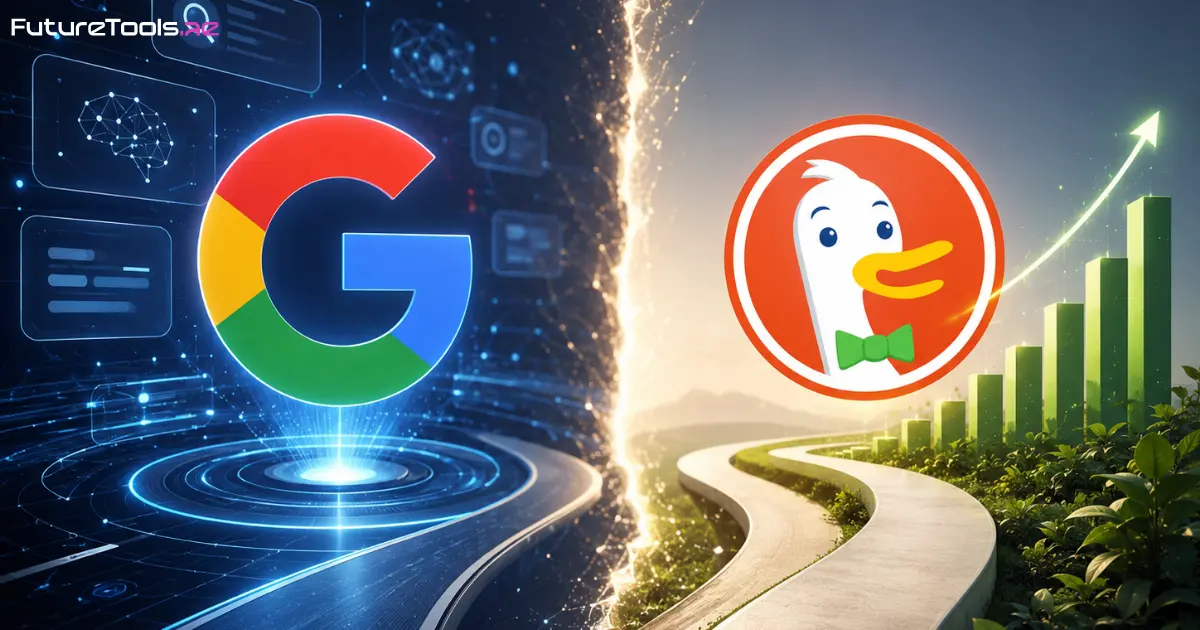
That tension has created a surprising winner: DuckDuckGo.
After Google’s latest AI Search push, DuckDuckGo says traffic to its “No AI” search page tripled. The page is simple. It offers private search without AI-assisted answers, chat features, or AI-generated images in results. No big campaign. No viral ad. No complicated product launch.
Google moved aggressively toward AI, and some users looked for the opposite.
This is not just a story about DuckDuckGo. It is a signal that search is splitting into two different user behaviors: people who want fast AI answers, and people who still want to search, compare, verify, and decide for themselves.
Google used I/O 2026 to show a more AI-heavy version of Search. AI Mode became more central. The search box was redesigned around longer, more natural prompts. Google also introduced the idea of Search agents that can monitor information and bring users synthesized updates.
In simple words, Google wants Search to become less like a list of links and more like an intelligent assistant.
That is a massive shift.
For years, users typed a query, scanned links, opened a few pages, compared sources, and formed their own answer. AI Search changes that flow. It gives users a summarized answer first and makes links feel secondary.
Some users love that speed. Others do not.
That is where DuckDuckGo’s No AI page entered the conversation. DuckDuckGo already promotes privacy and user control. Its No AI search page gives users a way to search without AI answers or AI-generated images getting in the way.
The timing made the message powerful: Google pushed AI harder, and DuckDuckGo offered an escape route.
The people moving toward DuckDuckGo are not necessarily anti-technology. Many of them understand AI very well. That may be exactly why they want more control.
AI search can be helpful, but it also changes the relationship between users and information. Instead of seeing multiple sources, users may see one confident answer. Instead of choosing which website to trust, they may trust the AI summary by default. Instead of exploring the web, they may stop at the search page.
That makes some users uncomfortable.
There are a few clear reasons behind the backlash.
First, users worry about accuracy. AI answers can summarize quickly, but they can also make mistakes, miss context, or sound confident when the source material is more complicated.
Second, users want source control. Traditional search lets people compare multiple pages. AI search often decides which sources matter before the user even sees them.
Third, creators and publishers are worried about traffic. If AI answers satisfy the query directly on Google, fewer users may click through to websites.
Fourth, some users simply do not want AI everywhere. They may use AI tools for writing, coding, or brainstorming, but still prefer classic search when researching facts, products, health topics, financial topics, or current news.
That is the important part. The demand for No AI search is not always a rejection of AI. In many cases, it is a demand for choice.
From Google’s side, the direction makes sense.
Search behavior is changing. People ask longer questions. They use voice and images more often. They expect answers to feel conversational. Younger users are already comfortable asking AI tools for help instead of searching through ten links.
Google also cannot ignore competitors like ChatGPT, Perplexity, Claude, and other answer engines. If users are moving toward AI-first discovery, Google has to protect its position.
So Google is trying to turn Search into an AI assistant before someone else does.
That is smart business.
But there is a risk. When a market leader moves too fast, it can create a gap between what the company wants to build and what a portion of users are ready to accept.
That gap is where alternatives grow.
DuckDuckGo did not need to convince everyone to abandon Google. It only needed to stand clearly for one thing Google is making harder to find: a cleaner, more traditional, less AI-driven search experience.
DuckDuckGo’s biggest advantage right now is not that it has no AI. In fact, DuckDuckGo also offers optional AI tools. The real advantage is that it is making AI feel optional.
That word matters.
Optional AI feels useful. Forced AI feels intrusive.
Users do not mind innovation when they can control it. They get frustrated when a product they use every day changes its default behavior without a simple opt-out.
DuckDuckGo’s message is easy to understand:
Use AI if you want it. Turn it off if you do not.
That is a strong position in a market where many tech companies are adding AI everywhere by default.
The bigger story is that search is no longer one experience.
For quick answers, AI search is powerful. If someone wants to summarize a topic, compare options, plan a trip, understand a concept, or ask follow-up questions, AI Mode can save time.
But for deeper research, traditional search still matters. People may want to open sources, check dates, compare opinions, read original reporting, and decide for themselves.
That means we are moving toward two types of search:
| Search Type | Best For | User Mindset |
|---|---|---|
| AI Search | Fast answers, summaries, planning, brainstorming, comparisons | “Give me the answer quickly.” |
| Traditional Search | Research, verification, source checking, news, sensitive topics | “Let me inspect the sources myself.” |
The winner may not be one side. The winner may be the search engine that gives users both options without making them feel trapped.
For websites, blogs, and publishers, this shift is huge.
If AI Search gives users the full answer on the results page, simple informational content may lose clicks. Pages that only repeat basic facts are easier for AI to summarize. That kind of content becomes less valuable as a traffic driver.
But original content becomes more important.
Websites need to publish information that AI cannot easily replace, such as:
This is where FutureTools and other tech publishers need to focus. The goal is not just to answer “what happened?” The goal is to explain why it matters, what changes next, and how users, creators, and businesses should react.
AI can summarize news. But strong editorial judgment still matters.
The honest answer is: use both.
AI search is excellent when you want speed. It can help you understand a topic faster, generate ideas, compare options, and ask follow-up questions without opening ten tabs.
Traditional search is better when accuracy, source quality, and independent judgment matter. If the topic is medical, legal, financial, political, technical, or news-related, you should still check original sources.
The smartest users will not blindly accept AI answers or reject them completely. They will choose the right search mode for the task.
That is the future of search: not AI versus no AI, but AI when useful and classic search when control matters.
DuckDuckGo’s No AI traffic surge is a warning signal for the entire tech industry.
Users are not saying they hate AI. They are saying they want control over how AI enters their daily tools.
That difference matters.
Google is betting that the future of search is AI-powered, conversational, and agentic. DuckDuckGo is betting that a meaningful group of users still wants privacy, simplicity, and the ability to opt out.
Both can be right.
The web is not moving in one direction anymore. It is splitting into personalized AI answers on one side and user-controlled search on the other.
For businesses, creators, and publishers, the lesson is clear: do not build for only one version of search. Optimize for AI visibility, but keep creating content worth clicking. Make your content easy for AI to understand, but valuable enough for humans to read directly.
Because the next phase of search will not be about who gives the answer first.
It will be about who users trust to help them find the truth.
Google may be building the future of search, but DuckDuckGo is reminding everyone that not every user wants the future forced into every query.
Some people want AI answers. Some people want blue links. Many people want both.
That is the real opportunity.
The best search experience will not be fully AI or fully anti-AI. It will give users the freedom to choose how much help they want, when they want it, and when they would rather find the answer themselves.
At FutureTools, our view is simple: AI should make the internet more useful, not less open. The future of search should be smarter, but it should also remain transparent, flexible, and user-controlled.

Mehdi tracks the fast-moving world of AI, breaking down major updates, launches, and policy shifts into clear, timely news that helps readers stay ahead of what’s next.