Artificial intelligence is no longer just helping people write emails, generate images, or automate workflows. It’s now stepping into one of the most high-pressure environments on Earth: the emergency room.
A new Harvard-led study revealed that OpenAI’s reasoning-based AI model outperformed human physicians in several emergency room diagnostic and triage tasks a moment that could completely reshape modern healthcare.
And honestly? This isn’t some distant sci-fi prediction anymore. AI healthcare tools are already changing how hospitals process patient data, identify illnesses, and assist doctors during life-or-death decisions.
At FutureTools, we’ve covered hundreds of AI breakthroughs but this one feels different.
Because when AI starts outperforming trained doctors in complex medical reasoning, the conversation changes from “Can AI help?” to “How far can it go?”
Researchers from Harvard and Stanford tested OpenAI’s advanced reasoning model in real-world emergency room scenarios.
The AI was evaluated on:
The results were surprising.
According to the study, the AI system matched or exceeded expert physician performance across multiple stages of patient evaluation.
One of the biggest advantages?
The AI performed exceptionally well during initial triage — the earliest stage where doctors often have very limited information.
That’s a huge deal because emergency room decisions are often made under intense pressure with incomplete data.
Modern AI models are incredibly good at pattern recognition.
They can rapidly analyze:
Unlike humans, AI doesn’t get tired during a 14-hour shift.
It doesn’t forget obscure conditions because of stress or exhaustion.
And reasoning-based models can now process medical logic step-by-step, something older chatbots struggled with.
This new generation of AI systems behaves less like autocomplete and more like a medical reasoning assistant.
The researchers behind the study made one thing very clear:
AI is not replacing physicians.
Instead, AI is becoming a powerful second opinion system.
And that’s probably the most realistic future.
Doctors still bring:
But AI can dramatically improve speed and accuracy behind the scenes.
Think of it like this:
Future doctors may work with AI the same way pilots work with autopilot systems.
The human remains in control — but the machine becomes an intelligent co-pilot.
Emergency rooms are overloaded worldwide.
Patients wait hours.
Doctors are burned out.
Hospitals struggle with staffing shortages.
AI could reduce that pressure by helping with:
Faster Triage
AI systems can prioritize critical patients faster.
Early Disease Detection
AI can identify dangerous conditions before symptoms become obvious.
Reduced Diagnostic Errors
Medical mistakes remain a major global healthcare issue.
Administrative Automation
Doctors spend massive amounts of time on documentation instead of patient care.
AI can handle much of that repetitive work.
This is why healthcare AI startups are attracting billions in investment right now.
AI in healthcare also comes with major concerns.
Researchers warned that AI systems can still:
And healthcare isn’t a place where mistakes are harmless.
That’s why experts are pushing for controlled clinical trials before widespread deployment.
Trust, regulation, and human oversight will become critical parts of AI healthcare adoption.
We’re already seeing explosive growth in medical AI platforms.
Some tools focus on:
This is quickly becoming one of the fastest-growing sectors in artificial intelligence.
If you want to stay updated on emerging AI healthcare tools, FutureTools regularly tracks the latest platforms shaping the future of medicine.
You can also explore our growing collection of AI tools here.
This story is actually bigger than medicine.
It shows how advanced reasoning AI is evolving beyond simple chatbot tasks into high-stakes professional work.
We’re entering an era where AI can assist in:
The emergency room is just one example of a much larger shift happening across every industry.
And the pace is accelerating faster than most people expected.
The most likely future isn’t AI hospitals replacing doctors.
It’s hybrid healthcare.
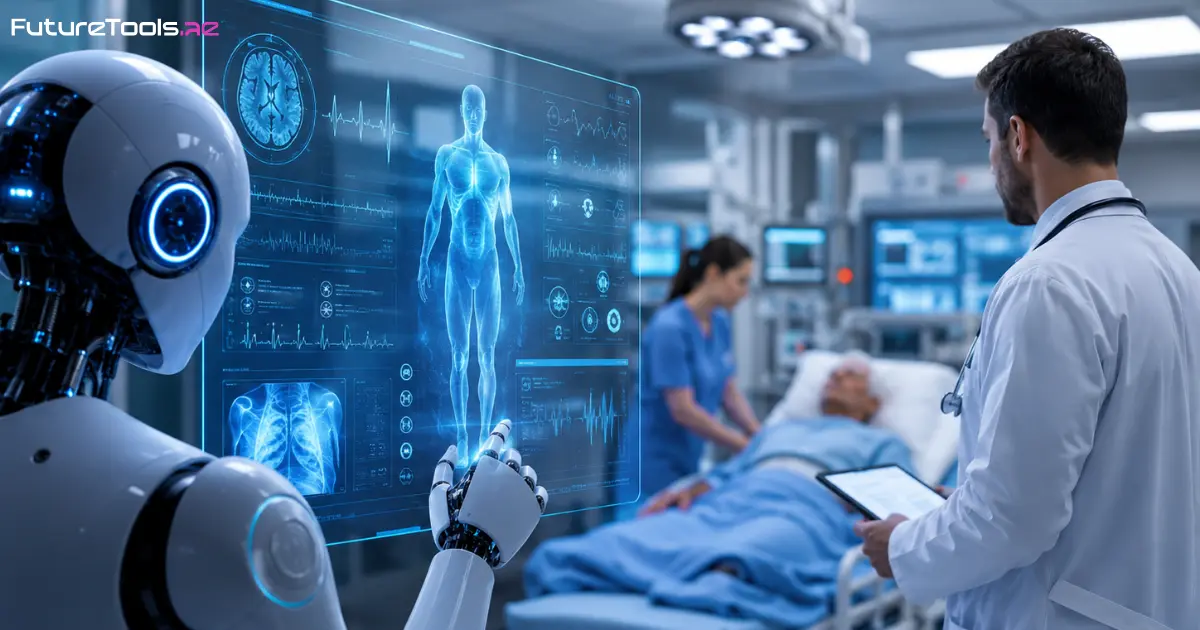
Imagine an emergency room where:
That future is starting now.
And whether people are excited or nervous about it, AI is officially becoming part of modern medicine.
The idea of AI helping save lives in emergency rooms once sounded impossible.
Now it’s backed by Harvard research.
We’re witnessing the early stages of one of the biggest healthcare transformations in decades — powered by artificial intelligence, reasoning models, and real-world clinical data.
The technology still has limitations.
Human doctors remain essential.
But the direction is becoming impossible to ignore.
AI isn’t just entering healthcare.
It’s becoming part of the medical team.

Alex reviews AI tools hands-on, testing features, pricing, and real-world use cases to help creators, founders, and teams choose the right tools with confidence.