Google is making a direct play for the next phase of online shopping: AI agents that don’t just recommend products, but actually complete purchases.
On January 11, 2026, Google announced a new open standard called Universal Commerce Protocol (UCP) at the National Retail Federation (NRF) conference. The goal: standardize how AI agents interact with retailer systems across the full customer journey from discovery to checkout to post-purchase support.
This is the kind of shift that quietly changes everything. When shopping experiences move inside conversational AI, the winners are the companies that control the rails. And right now, Google is positioning protocol suits as those rails.
According to TechCrunch, UCP was developed with major commerce players like Shopify, Etsy, Wayfair, Target, and Walmart. Instead of every assistant building one-off integrations with every merchant (and vice versa), UCP aims to provide a shared “language” so AI agents can work across different parts of the buying process without brittle custom connections.
Google also says UCP is designed to work alongside other agentic standards, including Agent Payments Protocol (AP2), Agent2Agent (A2A), and Model Context Protocol (MCP) and that businesses can adopt the pieces (extensions) they actually need.
In plain terms: UCP is a framework that helps agents ask commerce systems the same types of questions and perform the same types of actions, consistently. That’s why protocol suits are suddenly a serious competitive advantage, not a nerdy footnote.
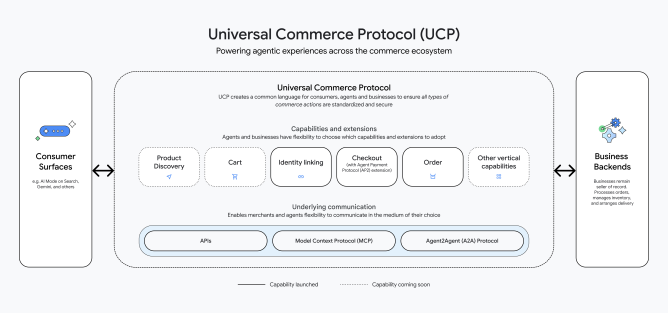
credit: Google
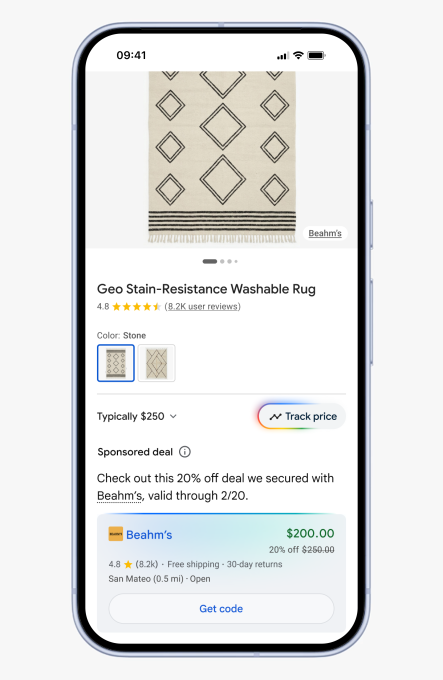
Google isn’t waiting years to apply this. The company said it will soon use UCP for eligible product listings in Search AI Mode and the Gemini apps, enabling shoppers to check out directly from U.S.-based retailers while researching a product. Users will pay with Google Pay and pass shipping info stored in Google Wallet, with PayPal support coming soon.
That’s a meaningful change in user behavior: fewer clicks, fewer abandoned carts, and more purchases happening inside Google’s AI surfaces—where Google controls discovery.
This is also where protocol suits become a traffic story. As more product research happens in AI chat experiences, the brands that show up cleanly (with the right attributes and inventory signals) stand to capture higher-intent shoppers.
TechCrunch also reports Google is rolling out new Merchant Center data attributes to help sellers feature items more effectively in AI-driven search surfaces.
At the same time, Google is letting merchants integrate a branded, AI-powered Business Agent in Search to answer customer questions—similar to a virtual sales associate. Google said brands including Lowe’s, Michaels, Poshmark, and Reebok are already using it.
Add it up and the direction is clear: discovery, Q&A, conversion, and support are being pulled into one agentic flow powered by protocol suits underneath.
credit: Google
If you’re wondering what this unlocks beyond a flashy “buy button,” think in terms of practical AI agent use cases: agents that can compare prices across retailers, validate variants, apply promotions, confirm delivery windows, place an order, and even initiate a return—without the user jumping between tabs.
That’s exactly what standards are good for: reducing the chaos of integrations so execution becomes reliable.
And it’s not just Google. TechCrunch notes competitors across tech and retail—including Amazon, Walmart, and OpenAI—are pushing standards and products that infuse AI into more of the shopping experience.
One reason Shopify matters in this coalition is checkout friction. Shopify’s accelerated checkout, Shop Pay, functions like a Shopify wallet experience by saving shipping and payment details to speed future purchases across Shopify stores.
In an agentic commerce world, saved identity + saved payment + clear permissions become essential because users will expect agents to execute faster, but still safely.
Adobe recently reported that traffic driven to seller sites by generative AI grew 693.4% during the holiday season, though it didn’t specify how much translated into sales.
That stat matters because it frames why protocol suits are arriving now. The top of the funnel is shifting to AI and the next fight is the bottom of the funnel: checkout.
If UCP adoption expands, expect three near-term shifts:
more “native” purchases inside AI chat and AI search
higher pressure on product data quality and structured attributes
a new optimization playbook—part SEO, part commerce infrastructure
And yes, you’ll likely see a wave of startups (often branded on a .ai domain) building tools that help retailers become “agent-ready”—from catalog cleanup to agentic CX to automated merchandising.
Because in 2026, the big retail question is no longer “Can AI recommend?” It’s “Can AI execute?” And Google is betting that protocol suits, starting with UCP, make the answer “yes.”